
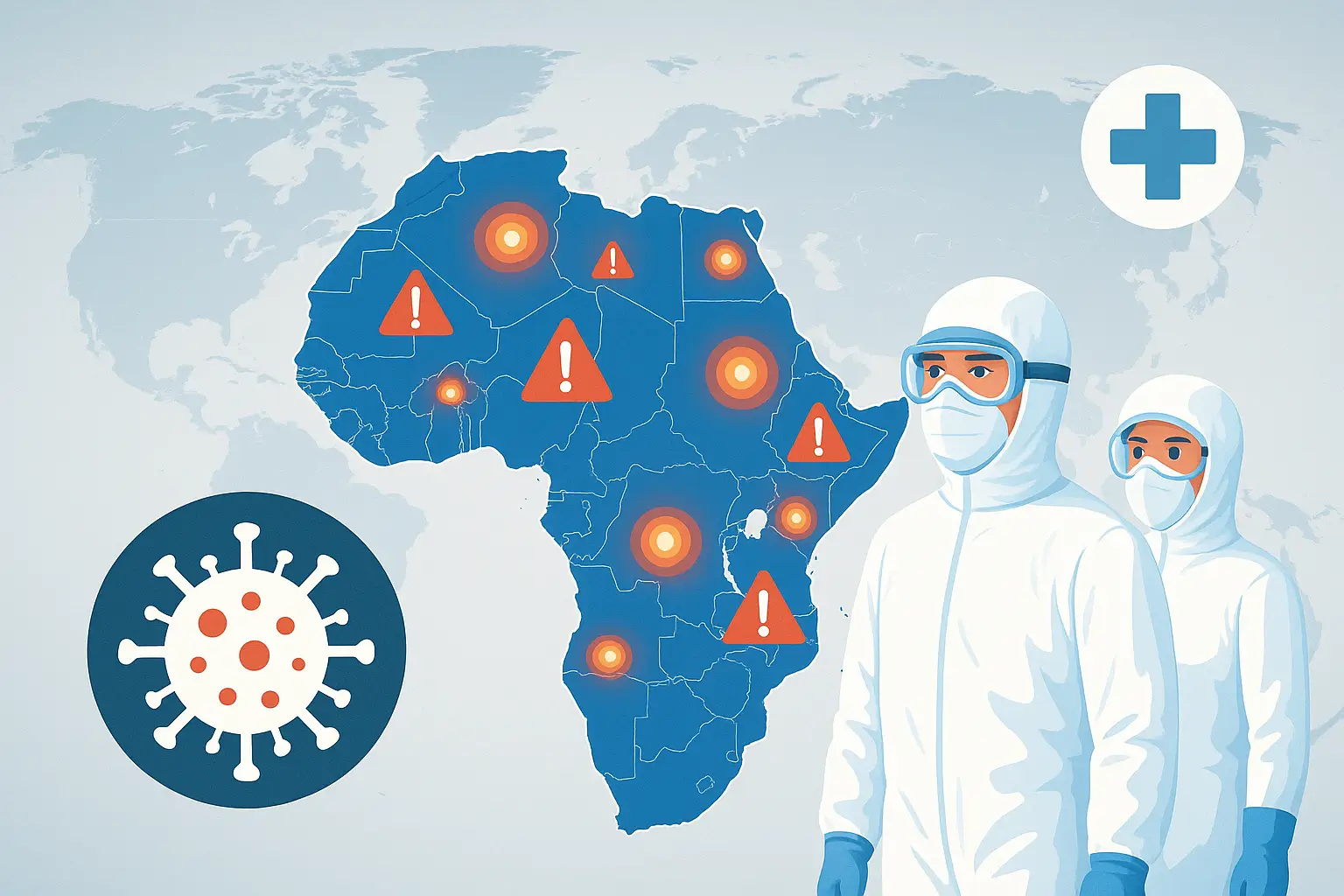
Across Africa, health systems are being put to the test. The Africa Centre for Disease Control and Prevention (Africa CDC) has issued a stark warning, the continent is facing a wave of rising disease outbreaks — from cholera and Mpox to measles, dengue, Marburg virus and Lassa fever. These mounting threats are placing already fragile and under-resourced health infrastructures under severe strain.
During Africa CDC’s weekly virtual briefing, Yap Boum — the agency’s Incident Manager for Health Emergencies — underscored the gravity of the situation. According to him, the surging number of outbreaks across multiple countries reveals gaps in preparedness, surveillance, and rapid response capacity. He reiterated that “sovereignty begins with preparedness,” calling on African governments and international partners alike to align efforts for a more secure and sovereign health future.
What the Numbers Say: A Worrying Trend
Data collected for epidemiological weeks 1 through 47 of 2025 paint a troubling picture of a continent under mounting health pressure. Among the major outbreaks: Nigeria Info, Let’s Talk!
-
Mpox: 132,442 suspected cases, 40,218 confirmed cases, and 953 deaths.
-
Cholera: 301,561 suspected cases, 10,057 confirmed, and 7,187 fatalities.
-
Measles: 140,217 cases and 1,243 deaths were reported.
-
Dengue fever: 6,062 confirmed cases with 139 deaths.
-
Lassa fever: 1,023 confirmed cases and 192 deaths.
Moreover, a new outbreak of the deadly Marburg virus disease has emerged in the town of Jinka, as of early December, Ethiopia authorities confirmed 13 cases and eight deaths. Rapid response teams are now deployed for contact tracing, active surveillance, and containment measures
These numbers reflect not isolated events — but part of a broader, concerning trend and multiple infectious diseases are resurfacing simultaneously across different countries, revealing deep structural vulnerabilities in public health readiness.
Mixed Outcomes: Some Progress, Some Setbacks
It’s not all gloom. There are signs that coordinated responses can — and do — work. For instance, the Democratic Republic of the Congo recently declared the end of its 16th Ebola virus disease outbreak (first reported in September), a milestone hailed by Africa CDC as the result of “exceptional determination and exemplary coordination.”
Similarly, for Mpox, vaccination efforts are underway: 18 African countries have now approved the MVA-BN vaccine, and approximately 4.88 million doses have been delivered to 16 of those countries. As of now, 1.91 million people have received at least one dose.
Yet these bright spots remain overshadowed by the scale and speed of new outbreaks — and the systemic challenges that continue to hamper effective response.
Why Africa Is So Vulnerable: Underlying Challenges
A closer look reveals why this crisis is unfolding the way it is. According to Africa CDC, several factors are contributing to the rising burden of disease: weak water and sanitation infrastructure, poor hygiene, overcrowding in many regions, climate pressures (including floods and floods-related disruption), limited access to quality healthcare, underfunded health systems — and critically, a shortage of local capacity to produce and distribute essential medical supplies.
Compounding these issues is the lack of robust real-time surveillance, early warning systems, and rapid response capacities. Many African countries still rely heavily on external assistance when outbreaks occur, leaving them vulnerable to delays in supplies, limited access to diagnostics, and insufficient healthcare staff.
As Africa CDC emphasized, achieving health security and the ability for African nations to prevent, detect, and respond to outbreaks on their own — demands long-term commitment. That includes investing in domestic financing, building local manufacturing capacity for drugs and vaccines, and strengthening early-warning and data-driven surveillance systems.
What Must Be Done: Toward a Resilient, Self-reliant Health Future
In light of this unfolding crisis, there are some clear priorities. First, African governments — including our own here in Nigeria — must treat public health security as a national priority. That means not just reactive funding during outbreaks, but sustained investment in infrastructure: clean water supply, sanitation systems, sewage treatment, safe housing, and access to quality healthcare.
Second, there must be a push for local manufacturing of essential medical supplies — vaccines, diagnostics, therapeutics — to reduce dependence on global supply chains, which can be disrupted during crises. This aligns with Africa CDC’s own call for “sovereignty.”
Third, strengthening disease surveillance and early-warning systems is essential. That means more laboratories, trained personnel, real-time reporting networks, and community-level monitoring. In addition, rapid response teams — equipped and ready — must remain active and responsive.
Fourth, public health education and community engagement must be ramped up. Citizens need accurate information on prevention, hygiene, vaccination, and early signs of illness. Outbreaks often worsen because people lack awareness or are unable to access care.
Finally, partnerships — between African governments, regional health bodies, international organizations, and local communities — must be deepened. Shared commitment, coordinated action, and resource pooling are critical if the continent is to overcome these overlapping threats. As Africa CDC noted, “progress requires shared commitment, with Africa leading and partners aligning.”
What This Means for Nigeria — and for You
If you’re in Nigeria (as I am, based in Port Harcourt), this rising wave of disease outbreaks is not a distant problem. It’s a wake-up call. Poor water supply, inadequate sanitation, overcrowded living areas, seasonal floods — these are all realities many communities face.
This is the right moment for citizens to demand more from our leaders: better public-health financing, improved water and sanitation infrastructure, local capacity for diagnostics and treatment, and robust outbreak preparedness.
On a personal level: stay informed about ongoing outbreaks, ensure your vaccinations are up to date, practice good hygiene and sanitation, and support community-level health awareness.
Because ultimately, a secure health future for Africa isn’t just about reacting to crises — it’s about building resilience, sovereignty, and the capacity for prevention.
Let us all — governments, institutions, communities, individuals — commit to doing our part.